
China’s AI Selloff Is Real, but the Bubble Verdict Is Not

Chinese artificial intelligence stocks have fallen sharply in a little over three months, and talk of a burst bubble has followed. Reuters concluded in an Oct. 26 analysis that China’s AI bubble has already burst. The size of the fall checks out, but whether that verdict follows is worth examining more carefully.
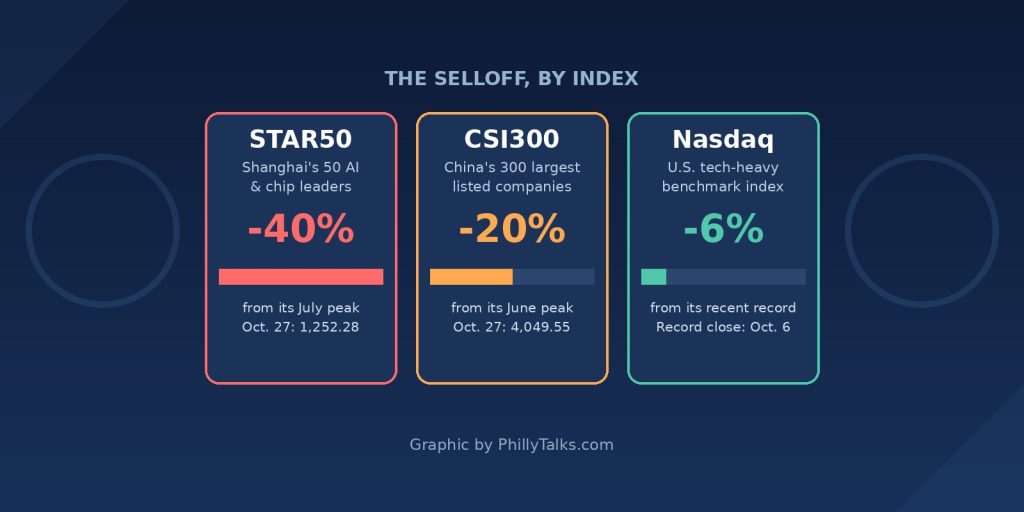
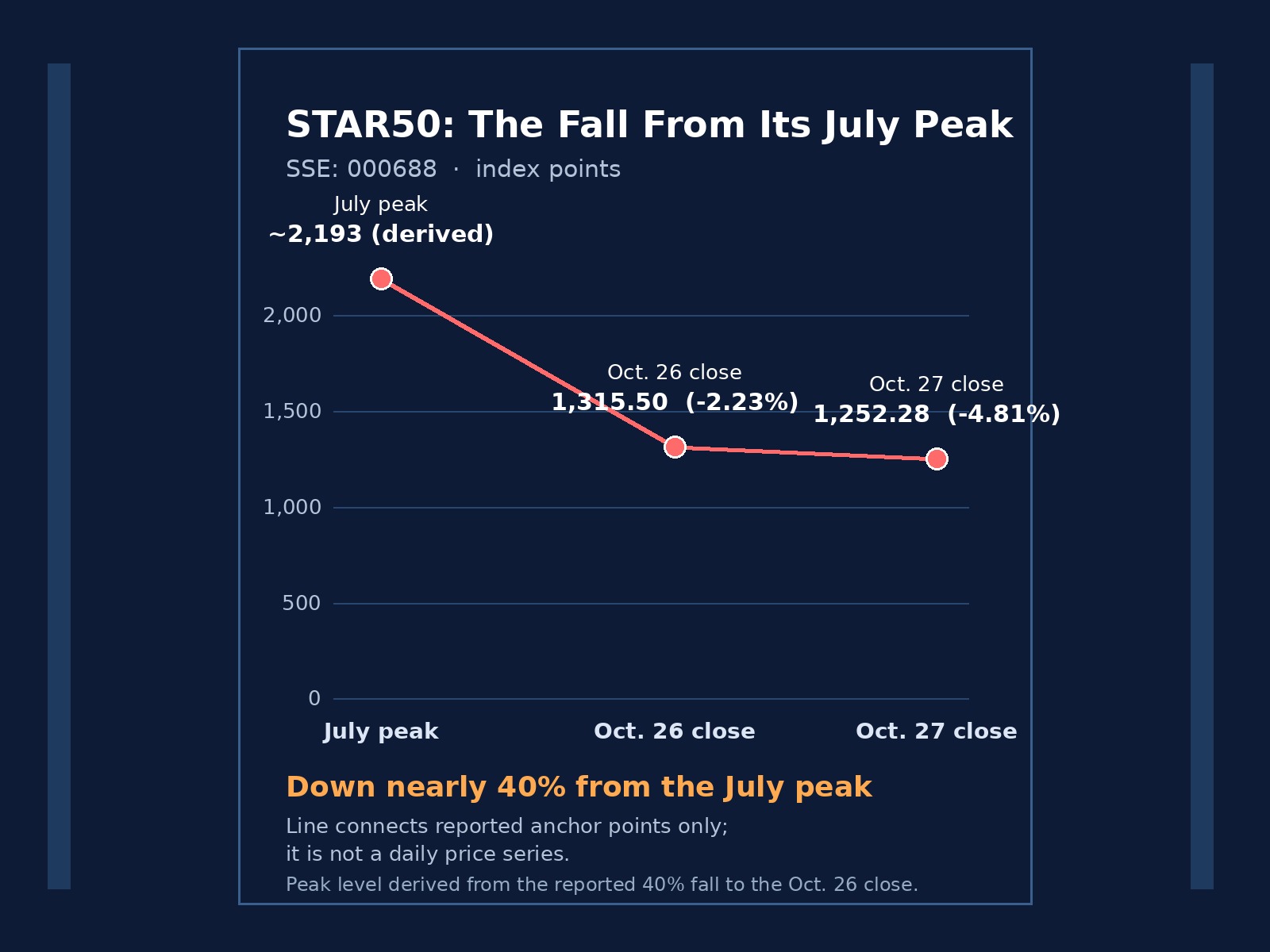
What happened is relatively clear. The STAR50 index, which tracks 50 leading technology companies listed on Shanghai’s STAR Market, has fallen nearly 40% in less than four months. About $480 billion in market value, the total worth of those companies’ shares, has disappeared, according to Reuters. That figure covers the STAR50 only, not all of China’s AI companies. The CSI300, an index of the 300 largest companies listed in Shanghai and Shenzhen, is down about 20% from its June peak. The STAR50 closed at 1,315.50 on Oct. 26 and fell further the next day to 1,252.28. The decline was still going after the article appeared.
The falls in individual stocks are larger. Unitree, a robot maker whose share offering drew 8,000 times more orders than the shares available, has lost half its value since trading began in August. Memory chipmaker CXMT has fallen more than 25% in a month. MetaX and Moore Threads, which jumped 700% and 400% on their trading debuts last year, have fallen back by about half since July. Optical parts makers Zhongji Innolight and Eoptolink are down about 60% from their highs.
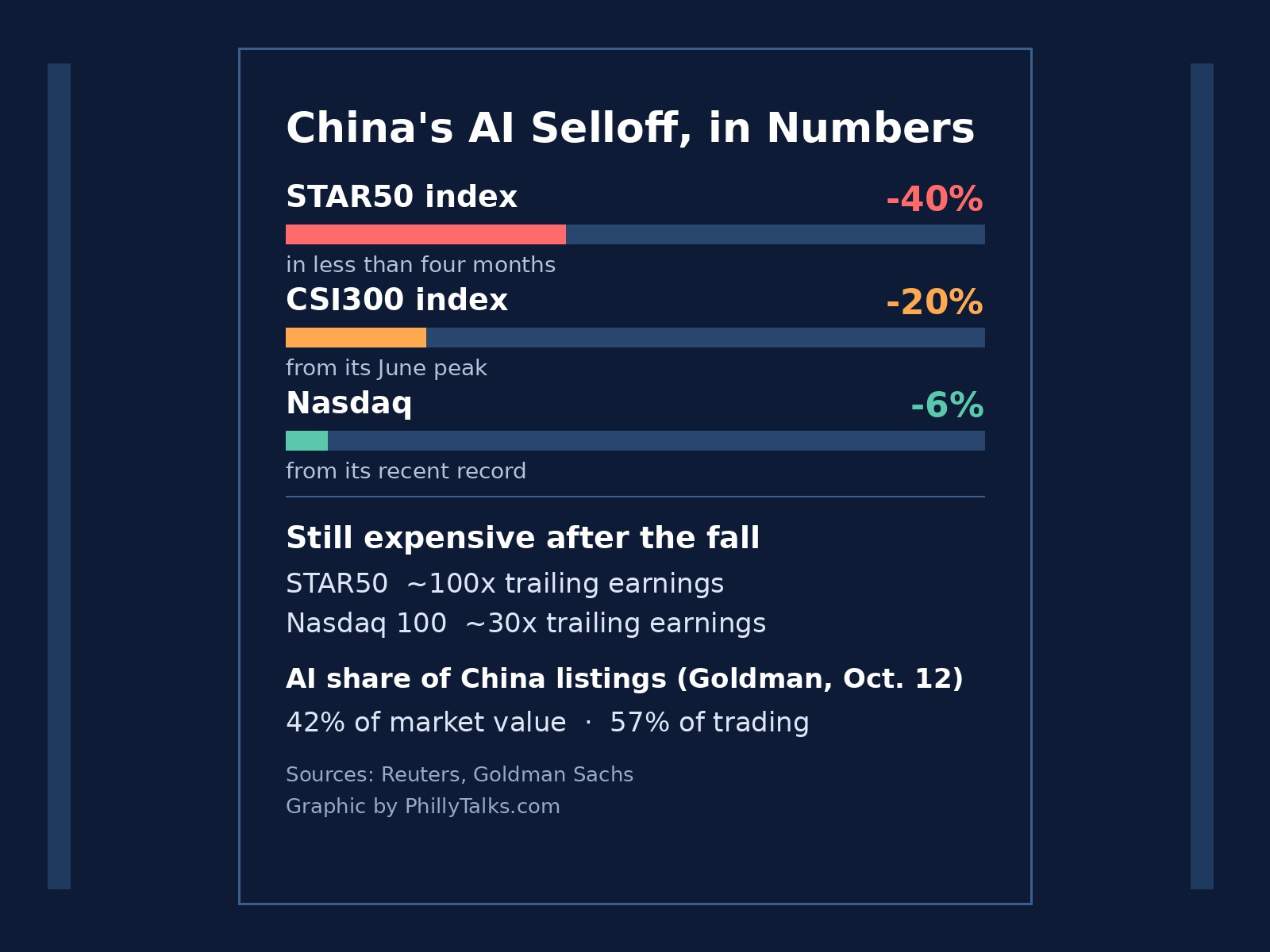
Why they fell is less settled, and the evidence is not all of the same quality. The strain from valuations can be measured. The STAR50 trades at about 100 times trailing earnings, a ratio that compares a share price with the profits a company already earned, against about 30 times for the Nasdaq 100. Measured against expected future profits instead, the gap narrows, but the direction does not change. Even after the fall, Chinese AI stocks still look expensive.
Other explanations are closer to speculation. Reuters itself wrote that there was no obvious selling trigger. Tax pressure has been mentioned, but it comes from a move to tax income from offshore trusts, which falls hardest on founders of Hong Kong and U.S.-listed companies, an indirect effect rather than a direct hit on these stocks. The U.S. action against the optical parts makers is not an enacted blanket ban either. A Senate bill introduced Sept. 25 would bar federal agencies, not all American buyers, from buying the two companies’ optical transceivers, the components that carry data as light signals, and it allows a five-year transition.
Regulation and state institutions do not point in one direction either. Curbs on leveraged trading, buying stocks with borrowed money, and on high-frequency trading, computer-driven trading done in fractions of a second, have been policy since early this year, but no new October directive has been confirmed. State institutions are said to have sold into rallies. Yet in the week ending Oct. 23, state-linked exchange-traded funds, funds traded on exchanges that track a basket of stocks, took in their largest inflows since April 2025, and the CSI300 rose 1.7% that day. Selling and buying have alternated with the week.
The counterarguments are substantial. A collapse in AI demand does not fit the CXMT case. The company forecast revenue for January through September at more than eight times the year-earlier level, swinging from a loss to a large profit, yet its shares fell anyway. That looks more like a repricing of valuations and financing conditions than a collapse in demand. Reuters also notes that some global banks still see Chinese AI stocks as a buying opportunity.
The weight of the theme in the market matters too. Goldman Sachs put AI-related stocks at 42% of market value and 57% of trading across mainland and Hong Kong listings. Those figures come from a report summarized Oct. 12, not a snapshot from Oct. 26. When one theme accounts for nearly half of all trading, its correction becomes an event for the whole market.
Comparisons with the United States need care. The Nasdaq is down only about 6% from a record set three weeks earlier. That alone does not prove the U.S. is safe, nor does China’s 40% fall prove it is a leading indicator for America. The share of small individual investors, the rules on borrowed-money trading, and the degree of policy intervention all differ. U.S. technology companies’ plans for data center spending are still rising.
There is also a policy paradox. Beijing has tried to break a long pattern of boom and bust and build a steadier market funded by ordinary savers, an effort often called the slow bull. But money poured into the AI theme until the market again looked like a speculative frenzy, in the words of Beijing fund manager Dong Baozhen, speaking to Reuters. He said the market later turned into a speculative frenzy and that the bubble is now bursting.
Much remains unknown. The exact peak level and date for the STAR50, how the $480 billion was calculated, and independent verification of the optical firms’ 60% falls have not been confirmed. How much tax, the bill, regulation, and state selling each contributed is hard to gauge. And the most important question is still open, whether artificial intelligence demand is faltering or prices simply ran ahead of results. Until that question is answered, the claim that China’s AI bubble has burst is better read as an interpretation than as a fact.