
Seoul and Washington Read the Same Commander in Opposite Ways

Remarks by Gen. Xavier Brunson, the commander of U.S. Forces Korea, at a seminar hosted by the Gold Institute for International Strategy in Washington on Oct. 14 set off a political storm in Seoul. During the same week in Washington, Brunson was moving from stage to stage as a central voice explaining the future of the alliance. Two capitals spent the same week reading the same general in opposite ways.
Brunson holds three commands at once. He leads U.S. Forces Korea, the South Korea-U.S. Combined Forces Command and the United Nations Command, the body that administers the 1953 armistice in and around the Demilitarized Zone and controls access to it.
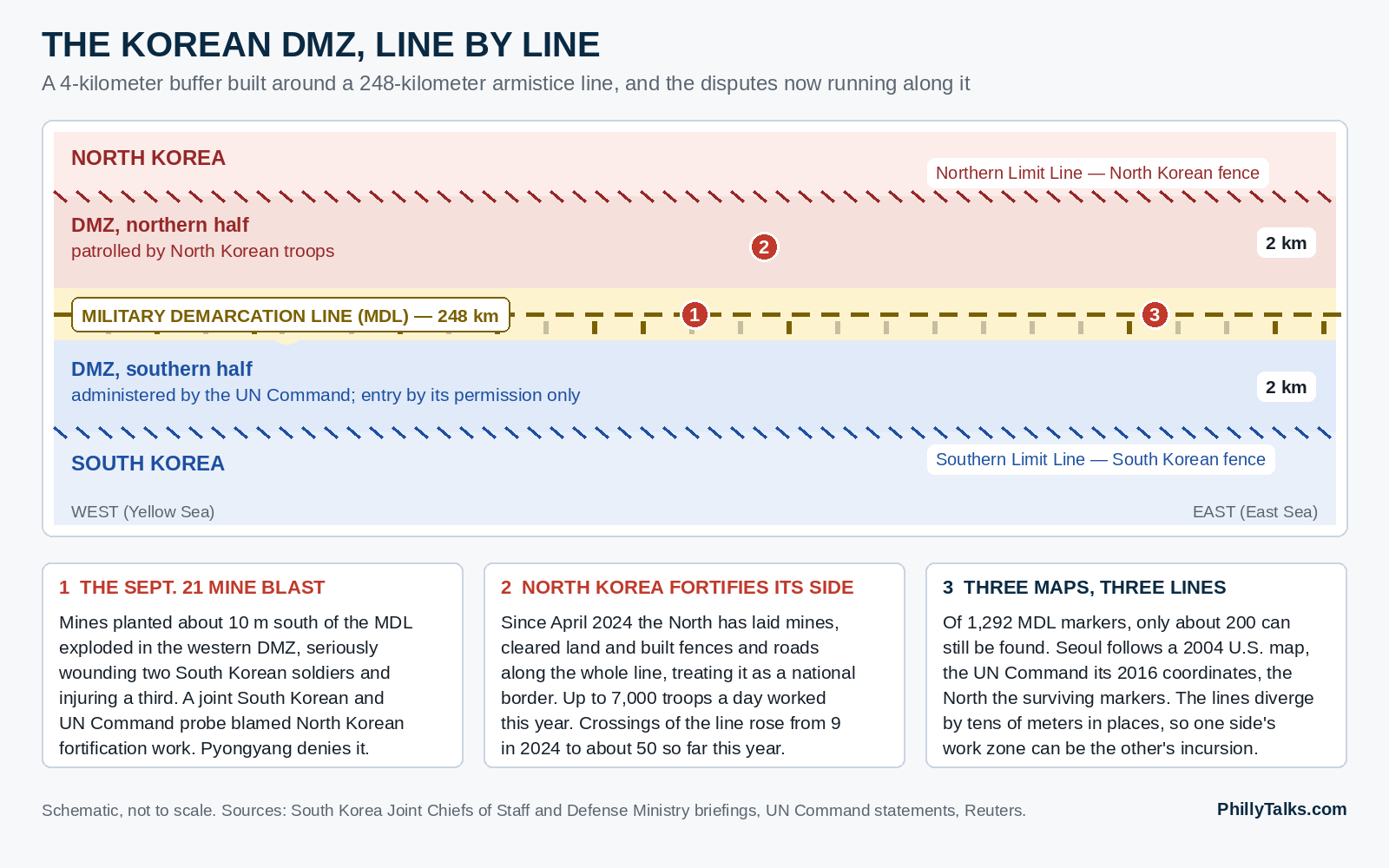
The Military Demarcation Line is not the 38th parallel drawn after liberation. The armistice drew a new line along the ground where the Korean War front finally stopped, running about 248 kilometers. The agreement set a demilitarized zone extending 2 kilometers on either side of the line, and South Korean forces built a fence along its southern boundary, the Southern Limit Line. The strip between the demarcation line and that fence is armistice-administered ground. Even South Korean troops and civilians need the United Nations Command’s permission to enter it.
A boundary under strain
The northern half works the same way in structure. North Korean troops run guard posts and fences along their side of the zone. What changed is how Pyongyang treats the line. After declaring in late 2023 that the two Koreas are separate and hostile states, North Korea began treating the line not as an armistice boundary but as a national border. Since April 2024 its troops have worked along the entire line, planting mines, clearing land and building fences and tactical roads. South Korea’s Joint Chiefs of Staff say as many as 7,000 personnel a day were mobilized this year and the work is 40% to 60% complete.
Work along a line produces friction along the line. North Korean crossings of the demarcation line rose from nine in 2024 to 17 last year and about 50 so far this year. On Sept. 21, mines planted about 10 meters south of the line exploded in the western sector of the zone, seriously wounding two South Korean soldiers and injuring a third. A joint investigation by the South Korean military and the United Nations Command concluded that North Korea had created minefields at several points south of the line during its fortification work. Pyongyang denied involvement, and Kim Yo Jong, the North Korean leader’s sister, dismissed the investigation as a staged farce and said the North would consider reinforcing tactical strike assets and resuming loudspeaker broadcasts against the South.
Part of the problem is that the line is not fixed on the ground in any single agreed form. Of 1,292 markers installed along the line after the armistice, only about 200 can still be identified. South Korea’s military follows a line taken from a 2004 U.S. military map, the United Nations Command follows coordinates it compiled in 2016, and North Korean troops appear to follow a line connecting the surviving markers or a reference of their own. The three lines diverge from one another along stretches of the zone, so work that North Korean troops regard as inside their own area can register in Seoul as an incursion.
The two sides also see the line through different law. For Seoul and the United Nations Command, the demarcation line is a provisional boundary managed under an armistice. Pyongyang is trying to fix it in place as a national border, which is why the same construction work is border defense in the North’s telling and an armistice violation in Seoul’s. There is no working channel to settle the differences at the working level. Inter-Korean military hotlines have been cut for years, and North Korea has not answered Seoul’s proposal, made last November, for military talks. Hong Min, a senior researcher at the Korea Institute for National Unification, read Kim Yo Jong’s statement as an effort to assign blame to the South in advance so the fortification work can proceed without disruption.
The remarks
At the seminar, Brunson asked where South Korea begins and ends, then answered that, from the perspective of the United Nations Command, it begins at the fence line south of the demarcation line. The strip between the two lines, he explained, is the area he manages to uphold the armistice. He put the fences at 2.5 kilometers on either side of the line. The actual distance is 2 kilometers.
At the same event, Brunson addressed the transfer of wartime operational control, known as OPCON, from the United States to South Korea. He said he supports the transfer, but added that conditions have changed and plans have changed, producing new standards that must be upheld. He cited North Korea’s advancing missile capabilities and pointed to the first quarter of 2029 as the timeline, drawn from a roadmap the U.S. military submitted to Congress in April.
The pushback in Seoul
South Korea’s government drew a line of its own. The Defense Ministry said on Oct. 18 that the remarks were Brunson’s personal views as United Nations commander and that its position on South Korea’s territorial sovereignty is firm. The United Nations Command said there is no question about South Korean sovereignty and that the remarks described the commander’s military and administrative responsibilities under the armistice.
The political reaction was sharper. Kim Byung-joo, a ruling Democratic Party lawmaker, former deputy commander of the Combined Forces Command and a presidential special adviser on defense policy, called the remarks a line-crossing infringement of territorial sovereignty, arguing that the armistice gives the United Nations Command authority only over access to the zone and civil administration. He demanded a retraction and an apology. Army Chief of Staff Kim Kyu-ha told a parliamentary audit that he could not agree with the remarks.
Seoul conveyed its concerns to Washington through multiple channels, and officials said on Oct. 19 that the United States responded that it fully recognized and shared them. The presidential office said Brunson’s comments about changing the transfer conditions do not represent the U.S. government’s position and that the two countries are consulting under their existing agreement. Defense Minister Kang Shin-chul told lawmakers on Oct. 15 that concerns about the OPCON remarks had already been delivered. President Lee Jae-myung said wartime operational control must be returned early and that consultations are proceeding in that direction.
Timing is Seoul’s most sensitive point. The government aims to complete the transfer by 2028, and in any case before Lee’s term ends in 2030. Chung Binna, the Defense Ministry’s spokesperson, said at an Oct. 15 briefing, speaking in a personal capacity, that if the goalposts keep moving, the transfer can never happen. The transfer is conditions-based rather than calendar-based, judged on South Korea’s core military capabilities and its ability to counter North Korea’s nuclear and missile threats, which is why a dispute over standards becomes a dispute over dates.
The view from Washington
Brunson’s week in Washington ran on a different track. On Oct. 12, at the Association of the United States Army’s annual meeting, he proposed moving beyond the allies’ two large command-post exercises toward training distributed across the peninsula, from Jeju Island to Gyeonggi Province, arguing that the war in Ukraine has shown how drones punish forces that stay in fixed positions. On Oct. 13, in a dialogue at the Center for Strategic and International Studies, he warned that North Korean troops fighting in Ukraine are learning how to deploy forces and run supply lines over long distances.
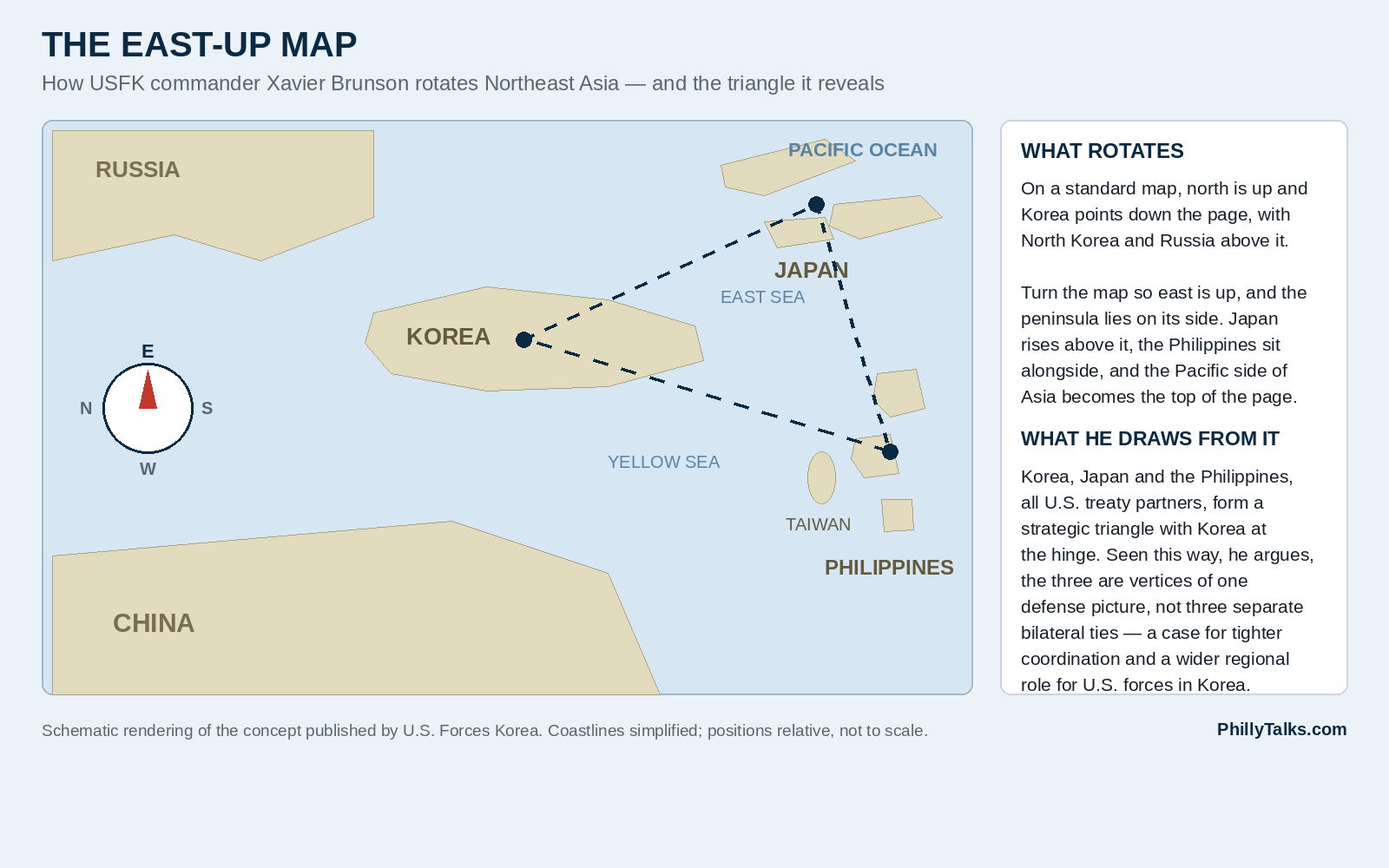
Since taking command, Brunson has promoted an east-up map that rotates the region to highlight a strategic triangle linking South Korea, Japan and the Philippines. In the Korea specialist community in Washington, the concept has drawn praise as an idea that could lead toward an integrated Northeast Asia command.
He has also pressed the case for strategic flexibility, citing the relocation of a Patriot battery from South Korea to the Middle East as an example of how U.S. forces in Korea should be usable beyond the peninsula when needed.
The U.S. government has made no public move to rein him in. A senior ruling-party figure in Seoul said Washington shares the view that the remarks were personal. News coverage itself split along the same line as the politics. In South Korea, broadcasters and newspapers led by the Yonhap News Agency covered the dispute daily, and it became an issue in parliamentary audits. American news organizations produced almost no coverage of their own. What reached English-language audiences was mostly a Reuters report from Seoul on Oct. 15 relaying the Defense Ministry spokesperson’s reaction, along with the English services of South Korean outlets. No original reporting on the controversy by The New York Times, The Washington Post or The Associated Press could be found. The Brunson news that U.S. defense trade publications carried that week was his training proposal at the Army conference, much of it drawn from Yonhap’s reporting.
What is actually in dispute
In the end, the two capitals are arguing about more than phrasing. Layered into one set of remarks are the reach of armistice-management authority, who sets the conditions and schedule for the command transfer and by what standard, and how fast the role of U.S. forces in Korea should widen from deterring North Korea to covering the wider Indo-Pacific.
In Washington, Brunson is read as the commander explaining that redesign. In Seoul, he is read as a commander who, from the very seat that judges the redesign’s conditions, spoke past a line. Analysts in both capitals see the episode less as a dispute over the alliance’s direction than as a sign that the negotiation over the terms and pace of getting there has now begun in earnest.