
Wall Street Splits Over the AI Debt Question as Chip Stocks Plunge

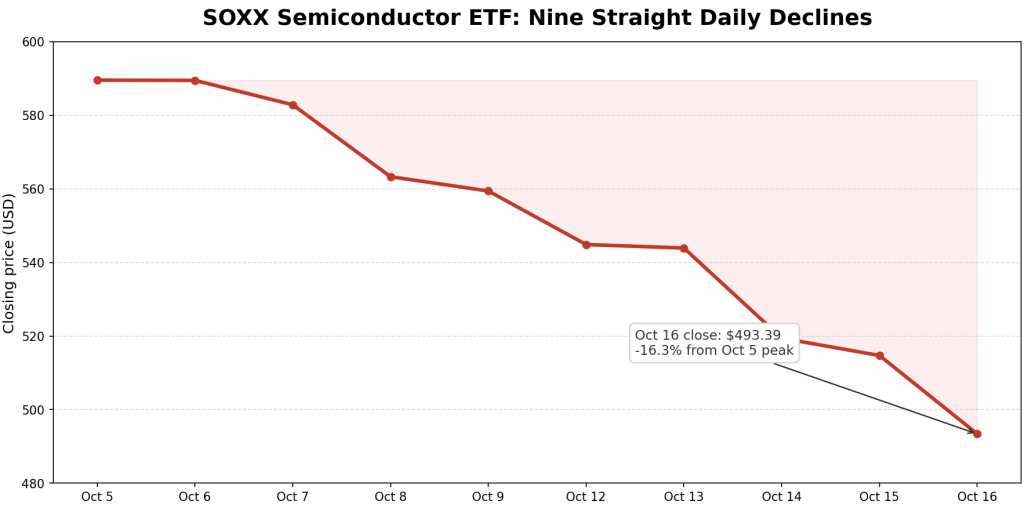
U.S. semiconductor stocks collapsed this week. The SOXX semiconductor ETF fell 12 percent in a single week, extending its losing streak to nine straight sessions, the longest in 16 years. The Nasdaq suffered its worst week since June.
The strange part is that earnings were not bad. TSMC, the world’s largest contract chipmaker, reported a 69 percent jump in third-quarter net profit, beating forecasts. Yet the stock fell anyway. Something other than earnings was moving the market.
That something was credit. Bond yields for CoreWeave, an AI cloud company, soared toward 15 percent. Its bonds entered distressed territory, and credit-default-swap spreads briefly topped 1,000 basis points. After Friday’s close, the Wall Street Journal’s headline said it plainly: “U.S. Stocks Fall as Credit Fears Haunt Tech Sector.”
Why does debt matter? AI data centers cost astronomical sums, and companies are borrowing to build them. When interest rates rise, interest burdens grow, and fatter interest payments mean thinner profits. Thinner profits mean less investment, and less investment cools the economy. Both the 2008 financial crisis and the 2000 dot-com bust followed that path.
The numbers show where things stand. The five biggest hyperscalers (Oracle, Microsoft, Meta, Amazon and Alphabet) carry $1.3 trillion in debt on their balance sheets, plus roughly $3 trillion in off-balance-sheet commitments, according to a Seeking Alpha analysis. Gartner estimates AI providers will spend $7 trillion on infrastructure through 2030 but generate no more than $3.6 trillion in AI-related revenue over the same period. Spending is double the revenue.
Wall Street is split over what it means.
First, the warning camp. JPMorgan strategist Nikolaos Panigirtzoglou said not to expect a rebound as fast as July’s, citing weak dip-buying appetite and shrinking corporate buybacks. JPMorgan CEO Jamie Dimon warned the odds of a market shock are higher than investors assume. The International Monetary Fund said that if doubts about AI monetization grow, equity values will evaporate and debts will become hard to service. BlackRock CEO Larry Fink said a slowdown in data-center construction could trigger a recession.
The calm camp pushes back. A Morgan Stanley co-president said there is no AI bubble, arguing that earnings have grown as fast as share prices. Goldman Sachs CEO David Solomon called the moment a “technology super cycle.” Saxo Bank said there is insufficient evidence of a systemic AI credit crisis. KeyBanc kept Micron as a top pick.
Notably, neither side is arguing about whether AI demand exists. The fight is over one question: whether that demand comes at a price the debt can bear. The warning camp watches financing; the calm camp watches earnings.
Expectations make the test harder. Analysts expect S&P 500 earnings per share to grow 27 to 29 percent in the third quarter, which would mark three straight quarters above 25 percent. Unusually, estimates were raised during the quarter, by 1.4 percent, while analysts typically cut forecasts by 2.2 percent, according to FactSet. A record 72 companies issued guidance above expectations, 44 of them in technology. The market’s bar is at the ceiling.
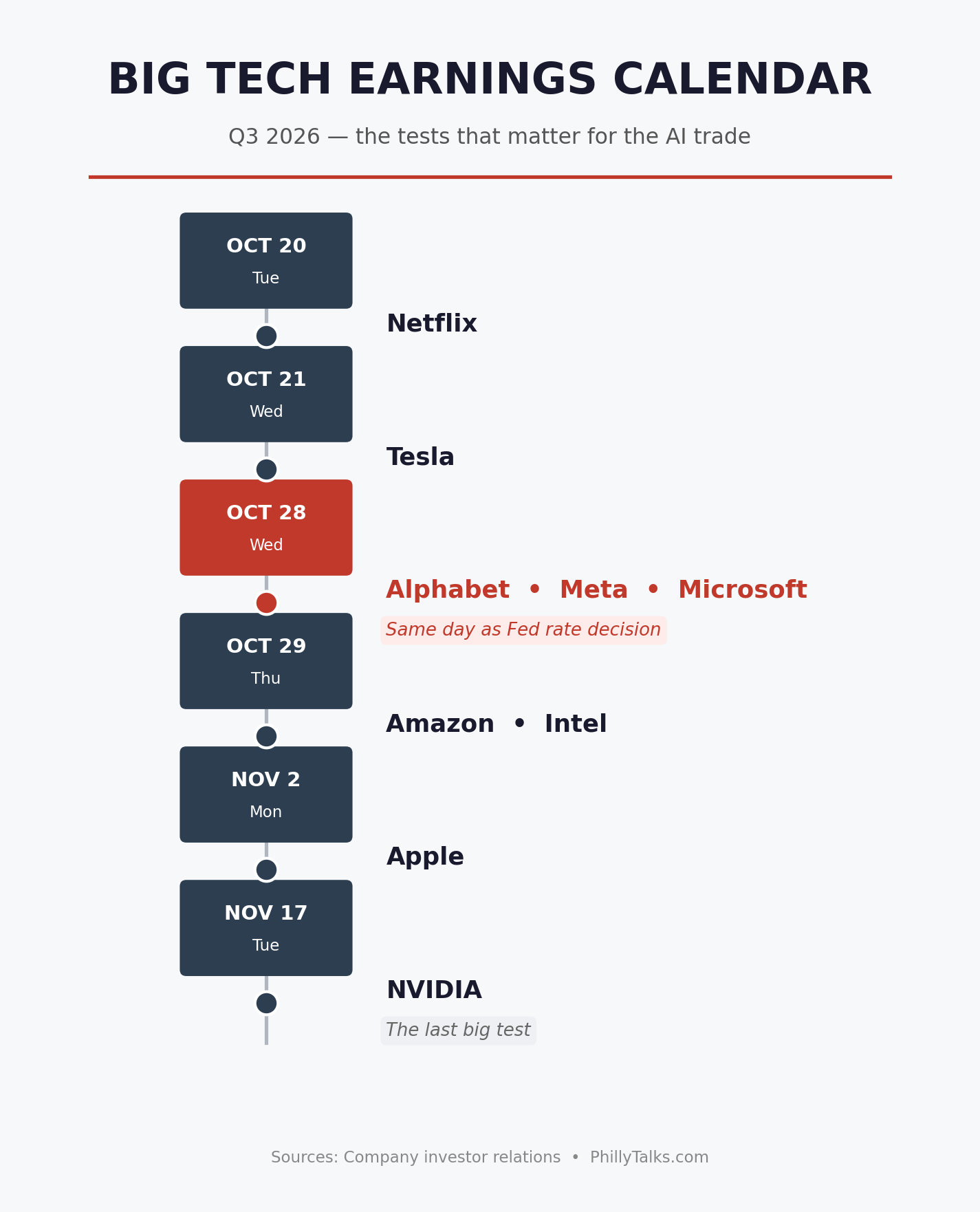
The next tests are scheduled. On Oct. 28, Alphabet, Meta and Microsoft report earnings, the same day the Federal Reserve announces its rate decision. December’s Fed meeting carries hike odds near 80 percent. This earnings season, three things matter: cloud revenue growth, capital-spending guidance for 2027, and whether AI monetization is catching up with investment.
This is not a moment for betting on fear or greed. It is a moment for measuring corporate stamina.