
Lula Wins Fourth Term in Brazil After Runoff Comeback

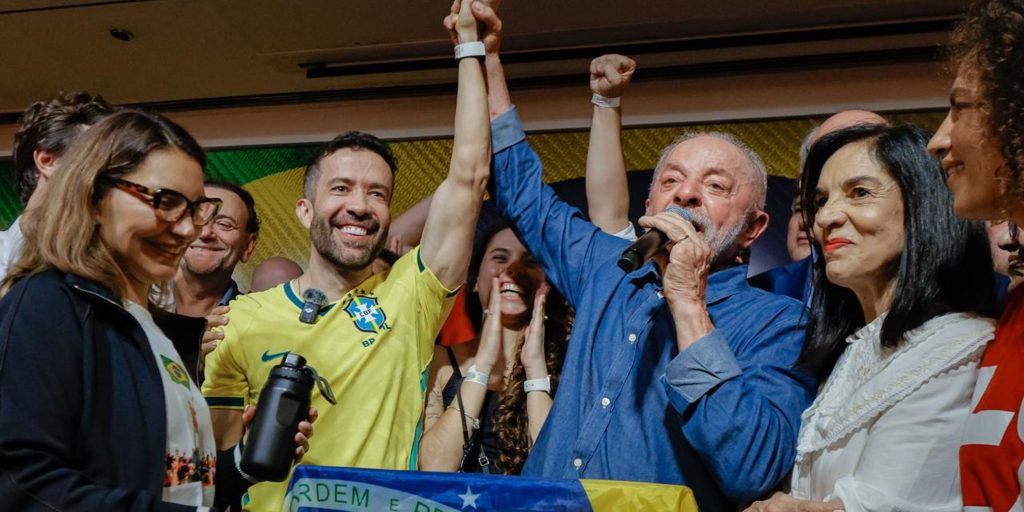
Luiz Inácio Lula da Silva won Brazil’s presidential runoff on Sunday, defeating Senator Flávio Bolsonaro to secure a historic fourth term, according to Brazil’s Superior Electoral Court.
With 99.77 percent of electoral sections counted, Lula had 51.76 percent of valid votes to Bolsonaro’s 48.24 percent, a margin of about 4.35 million votes, the court’s count showed. Lula received 64,078,503 votes to Bolsonaro’s 59,728,246, and the court marked the race as mathematically decided.
The result reversed the order of the October 4 first round, when Bolsonaro finished first with 47.03 percent of valid votes to Lula’s 45.16 percent. It is the first time since direct presidential elections resumed in 1989 that the candidate who finished second in the first round went on to win the runoff.
Lula, 80, is the first person elected president of Brazil four times, after his victories in 2002, 2006 and 2022. “I can assure you that we are going to change the way we govern this country. We are going to give the people a greater role in our decisions,” he said after his reelection. He thanked Brazilians for their “generosity,” especially young people who he said “took to the streets to defend democracy.”
Bolsonaro said he would not accept the result and would mount a legal challenge. “It is impossible to recognize the election result given how these events unfolded,” he told supporters in Brasília after Lula’s victory was declared. “We will take legal action. We will ask for this election to be annulled.” His challenge centers on the Supreme Court’s last-minute ruling to extend voting by two hours.
The campaign was dominated by concerns over the cost of living, crime and corruption, according to CNN. Lula’s victory bucks a broader rightward political shift across Latin America, and it is a major setback for the Bolsonaro political movement. Flávio Bolsonaro failed to accomplish what his father, former President Jair Bolsonaro, also could not do in 2022: defeat Lula at the ballot box.
Geography helps explain how Lula overturned his first-round deficit. In Minas Gerais, the state with Brazil’s second-largest electorate, he went from losing by nearly 590,000 votes to winning by about 99,000, a swing of roughly 690,000 votes in the margin between the two candidates. The state has backed the winner of every direct presidential election since 1989. Lula also won all nine northeastern states and the capitals São Paulo and Rio de Janeiro, even as Bolsonaro retained his lead in those two states overall.
Turnout also rose. Abstention fell from 21.08 percent in the first round to about 19.2 percent in the runoff, bringing nearly three million more Brazilians to the polls. In the first round, the gap between the candidates was just over 2.2 million votes.
Lula’s supporters celebrated in Rio de Janeiro, hugging, beeping car horns and raising the “L” sign, while supporters in Belo Horizonte, the capital of Minas Gerais, chanted and sang, according to CNN. His fourth term begins on January 1, 2027.