The Day Humanoid Robots Take to the Streets Is Approaching

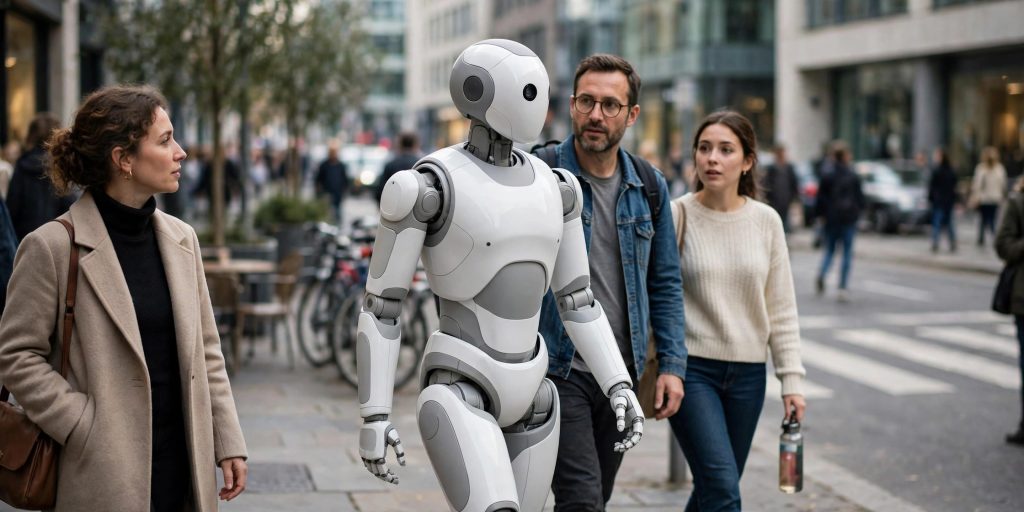
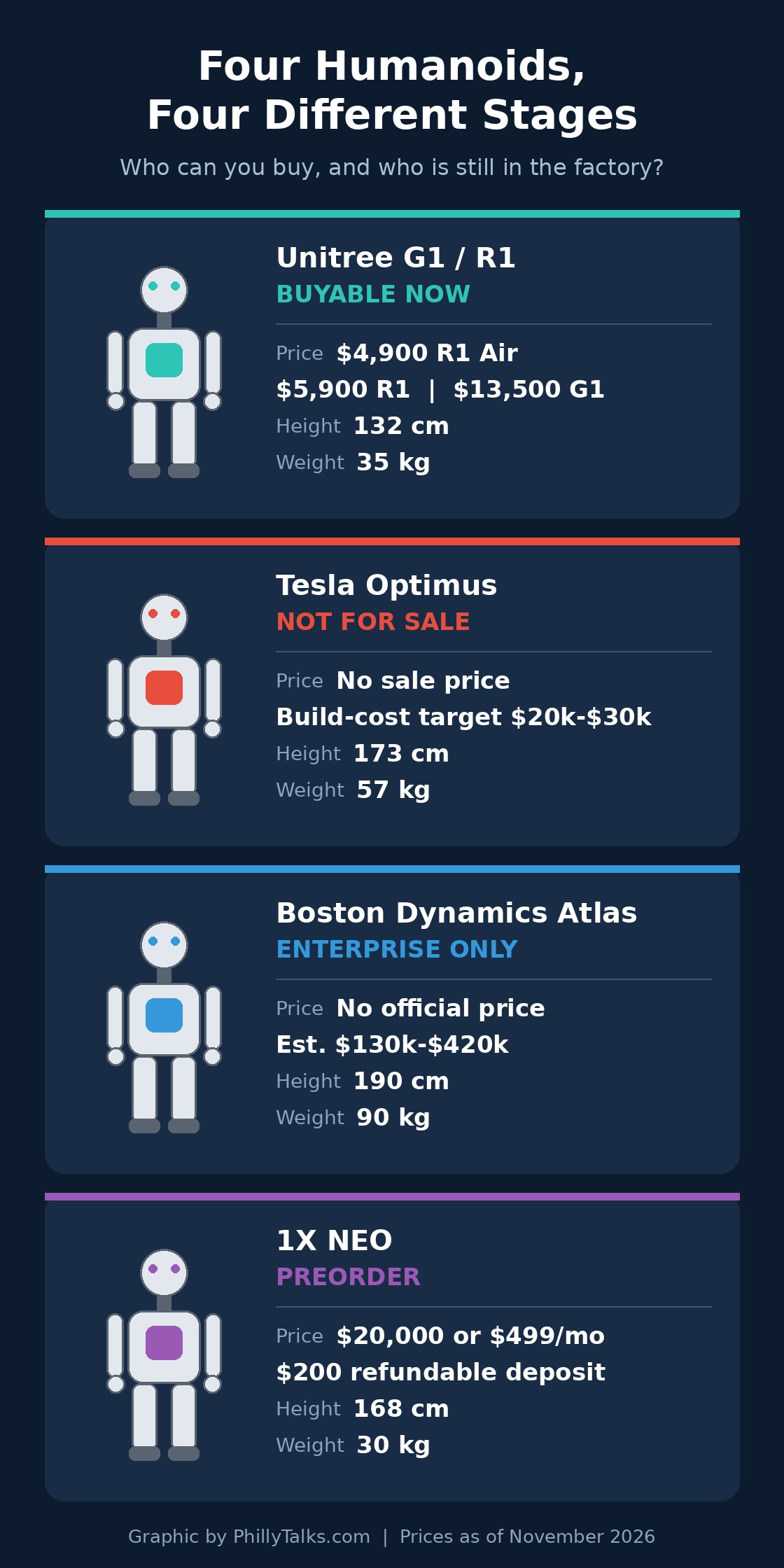
Only one humanoid robot is for sale right now. It is the R1 from Unitree of China. The base model costs $5,900, the lighter R1 Air costs $4,900, and the programmable R1 EDU costs $10,500. The prices are from Unitree’s own online store, before tax, shipping and customs duties. Shipping costs $300 to $1,200.
Unitree was founded in 2016 in Hangzhou, China. It first built robot dogs that walk on four legs, then released the G1 humanoid in May 2024. The G1 stands 132 centimeters tall, weighs about 35 kilograms, has 23 joints and runs about two hours on a charge. The base model starts at $13,500, but it does not support secondary development.
It can be bought in the United States. Orders go through Unitree’s own store and through the American retailer RobotShop, where the G1 costs $17,900. The Federal Communications Commission added foreign-made advanced robotic devices to its Covered List on July 28, 2026, but models authorized before that date can still be sold. The G1, the R1 and the Go2 fall in that group.
Why you never see one on the street
Still, almost nobody has seen a Unitree robot out for a walk. The buyers are different. They are mostly university labs, companies and content creators. The base models have no hands, so they cannot pick things up, and the battery lasts about one to two hours. The robots on sale today are closer to research and demonstration machines than to helpers.
Tesla’s Optimus is not for sale
Tesla’s humanoid, Optimus, cannot be bought at any price. There is no order page, no reservation and no waitlist. Third-party sites offering reservations are most likely scams.
Optimus was first unveiled in August 2021, when a person in a robot costume walked on stage. A walking prototype followed in September 2022, and the second generation appeared in December 2023. Production of the third generation began in October 2026 at the Fremont plant in California, on a Model S and Model X line converted in 46 days. Designed capacity is one million units a year.
The first 10,000 to 20,000 units will stay inside Tesla. They will gather the training data the robots need to teach themselves. Outside deliveries are targeted for around the end of 2027, with industrial customers first. Elon Musk said at an event on November 6, 2026, that Tesla will probably rent Optimus rather than sell it. The often-quoted $20,000 to $30,000 figure is a long-term target for build cost, not a sale price.
The third-generation Optimus stands 173 centimeters tall, weighs 57 kilograms and can lift 20 kilograms. It walks at about 8 kilometers per hour. Each hand has 22 joints. The battery holds 2.3 kilowatt-hours, with reported run times of four to eight hours. Musk acknowledged in January 2026 that no Optimus had yet done productive work in a factory, and some public demonstrations later turned out to have been driven remotely by people.
Boston Dynamics Atlas is headed for the factory
Boston Dynamics’ humanoid, Atlas, is not a consumer product. It is sold to enterprises, and no official price has been published. Industry estimates range from about $130,000 to $420,000.
Atlas stands 190 centimeters tall, weighs 90 kilograms and has 56 joints. It can lift 50 kilograms for a moment and 30 kilograms continuously. The battery lasts four hours, or two hours under heavy work. It is rated IP67 for dust and water.
The electric Atlas was unveiled at CES in January 2026. The hydraulic Atlas retired in April 2024. Boston Dynamics became a wholly owned subsidiary of Hyundai Motor Group in July 2026, when Hyundai bought SoftBank’s remaining stake.
Production for 2026 is already spoken for, going to Hyundai’s robotics center at the Georgia Metaplant and to Google DeepMind. Other customers will start receiving units in early 2027. Chipmaker GlobalFoundries, named on November 17, 2026, as the first adopter outside the auto industry, will test Atlas at its chip plants from early 2027.
The robot for the home, 1X NEO
The humanoid aimed at the home is NEO, from the Norwegian-American company 1X Technologies. Preorders opened in October 2025. Ownership under Early Access costs $20,000, and a subscription costs $499 a month. The deposit is $200 and fully refundable. United States deliveries were targeted to begin in 2026, but as of a check on November 1, 2026, no delivery to an ordinary paying home had been confirmed.
NEO stands 168 centimeters tall and weighs 30 kilograms. Its body is soft, under a washable knit suit. It can lift about 70 kilograms and carry about 25 kilograms. The battery lasts about four hours. The chores it is meant to do are tidying, fetching things, loading and unloading the dishwasher, and answering the door.
There is one condition. When NEO cannot do a task on its own, a 1X employee drives it remotely through a virtual-reality headset. The company calls this Expert Mode. The owner books and approves each session and can set no-go zones. Independent hands-on reports found that most of the demonstrated work was teleoperated. Cooking and full laundry cycles are teleoperated too, not autonomous.
Why robots fight and run in China
The scenes of humanoids fighting and running in China have a separate explanation. They are competitions and showcases, not everyday life. The first humanoid fighting tournament, held in Hangzhou on May 25, 2025, featured only Unitree G1 robots, driven remotely by people. A second edition followed in Chongqing on June 10, 2026.
At the Beijing humanoid half marathon on April 19, 2025, 21 robots ran with about 12,000 people. The Tiangong Ultra won in 2 hours 40 minutes 42 seconds, changing batteries three times. At the April 19, 2026, race, more than 300 robots from 26 brands took part, and Honor’s Lightning won autonomously in 50 minutes 26 seconds.
These events serve three purposes. They promote local-government industrial policy, they market the companies, and they test balance and the ability to get up after a fall.
The bottom line
The humanoid you can buy today is Unitree’s. The one aimed at the home is NEO. The ones headed for the factory are Atlas and Optimus. The three paths are still at different stages.