Indian Immigration to the United States Hit a Record, Then the Door Narrowed


For a quarter century, the flow of people from India to the United States moved in one direction and grew almost every year. Students arrived, graduates stayed for work, workers waited years for green cards, and a community of more than 5 million took shape. Then, in the fall of 2025, the flow bent.
The turn did not come from a single decision. It came from several at once: tighter student visa screening, a mass termination of student records that courts are still sorting out, a six-figure fee on new skilled-worker petitions, a rewritten lottery that favors higher salaries, and the sharpest border enforcement in years. The people already here mostly stayed. The people trying to come next found the door narrower.
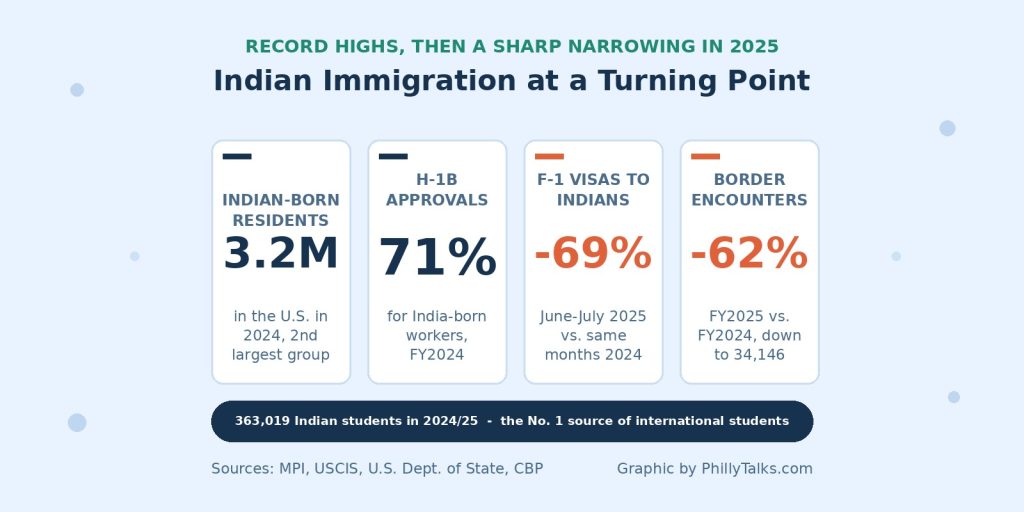
The scale of what was built before the turn is large. About 3.2 million people born in India lived in the United States as of 2024, according to the Migration Policy Institute, making Indians the second-largest foreign-born group after Mexicans. Counting their American-born children, the Indian American population numbers more than 5.2 million, according to the Carnegie Endowment for International Peace. The Pew Research Center estimates that about 725,000 Indians live in the United States without legal authorization.
A pipeline built on classrooms
The modern flow runs through American universities. A student arrives on an F-1 visa, works after graduation under Optional Practical Training, and, if an employer sponsors them, moves onto an H-1B visa for specialty occupations. The green card comes later, often much later.
The roots of the pipeline reach back to the Immigration and Nationality Act of 1965, which replaced country quotas with a system favoring family reunification and skills. The H-1B visa itself was created by the Immigration Act of 1990. Over time, Indian graduates filled American computer science and engineering programs and then American technology companies, in numbers no other country matched.
By the 2024-25 academic year, India was the top source of international students in the United States for the second straight year, with 363,019 students, about 31 percent of the total, according to the Open Doors report published by the Institute of International Education and the State Department. A year earlier, India had overtaken China for the first time since 2009, with 331,602 students, a 23 percent jump.
The workforce figures show where those students went. In fiscal year 2024, United States Citizenship and Immigration Services approved 399,395 H-1B petitions. Beneficiaries born in India accounted for 283,397 of them, or 71 percent. China was second at 11.7 percent. Nearly 64 percent of the approved jobs were in computer-related occupations, and systems analysis and programming alone accounted for 52 percent. The annual cap on new H-1B visas is 85,000, split between 65,000 regular slots and 20,000 for holders of advanced degrees from American universities.
The link between the classroom and the workplace is direct. Of the H-1B petitions approved in fiscal year 2024 for people already in the United States who requested a change of status, 71 percent came from holders of F-1 student visas or their dependents, according to the same federal report.
Students felt it first
The student channel was the first to bend. In fiscal year 2025, the State Department issued 28.2 percent fewer F-1 student visas than the year before, 287,915 in all. New international enrollment fell 17 percent in the fall of 2025, according to a survey of 828 institutions by the Institute of International Education.
Indian students absorbed the sharpest part of the drop. In June and July 2025, the two peak months before the fall semester, only 12,776 F-1 visas were issued to Indian students, down 69 percent from 41,336 in the same months of 2024, according to State Department data. By August 2025, arrivals of Indian students were down 45 percent from a year earlier, according to figures reported by the Graduate Management Admission Council.
The immediate cause was process, not just policy. The administration paused student visa interviews from late May to June 18, 2025, while it prepared expanded social media screening, compressing the entire peak season into a shorter window. A new 250-dollar Visa Integrity Fee took effect on October 1, 2025.
A second shock came from enforcement. Between March and May 2025, the government terminated the records of more than 4,736 international students in the Student and Exchange Visitor Information System, the database that tracks their legal status, according to program data submitted to congressional committees. More than 1,600 visa revocations were reported by early May. Most records were restored by April 25, 2025, after lawsuits, but revoked visas were not reinstated. The American Immigration Lawyers Association found that Indians accounted for half of the 327 revocation and termination cases it analyzed, and more than 8,000 F-1 visas have been revoked since January 2025. In March 2026, a federal judge in Massachusetts allowed a lawsuit challenging the mass revocations to proceed, after the government acknowledged running the names of about 1.3 million international students through a criminal records database, producing roughly 6,400 matches that included minor infractions.
The stock of students already enrolled has now begun to shrink as well. Active F-1 and M-1 students in the federal SEVIS database fell 7.1 percent in October 2026 from a year earlier, and active students from India fell 13.5 percent, according to Immigration and Customs Enforcement data.
The H-1B squeeze
The work channel narrowed next, and the change was structural rather than seasonal. On September 19, 2025, President Donald Trump signed Proclamation 10973, requiring a 100,000-dollar payment for certain new H-1B petitions for workers outside the United States. A federal district court vacated the fee on June 8, 2026, and an appeals court declined to block that ruling, but the White House extended the proclamation in September 2026, and litigation continues.
At the same time, the Department of Homeland Security replaced the random H-1B lottery with a wage-weighted selection system, effective February 27, 2026. Under the new rule, an entry-level offer receives one entry in the selection pool, while offers at the highest wage level receive four. The department projected selection chances of about 15 percent for the lowest wage level and about 61 percent for the highest.
Employers responded immediately, and the response fell hardest on the firms that had relied most on bringing workers from India. Registrations for the fiscal year 2027 cap season by India’s six largest information technology services firms fell about 92 percent, from 21,919 to 1,763, according to federal data reported by The Economic Times and The Hindu Business Line. Infosys fell from 8,886 registrations to 759, Tata Consultancy Services from 5,955 to 284, and Cognizant filed none, down from 3,752. Total registrations across all employers fell 38.5 percent, from 343,981 to about 211,600.
The reason is visible in how each company used the program. More than 85 percent of the initial H-1B receipts at Infosys, Tata Consultancy Services, Cognizant, Wipro and Tech Mahindra went through consular processing, meaning workers applying from outside the United States who needed a visa stamp. At Microsoft the share was 47 percent, and at Apple 39 percent, and their registration declines were far smaller. From September 21, 2025, through May 24, 2026, initial consular H-1B petitions fell 91.2 percent from the same stretch a year earlier, from 13,823 to 1,212, according to federal data.
The cap itself still filled. Citizenship and Immigration Services announced on July 17, 2026, that it had received enough petitions for all 85,000 slots, with no second lottery. Demand did not disappear. It moved inside the United States, toward workers already holding student or work status, and toward hiring in the United States itself.
Indian technology firms are adjusting the same way. They are hiring more in the United States, transferring workers who already hold H-1B status, and parking more work in global capability centers in India and in nearshore teams in Canada and Mexico. India’s total services exports reached a record 421.3 billion dollars in fiscal year 2026, suggesting the work continues, in different places.
The border went quiet, deportations rose
The irregular channel narrowed fastest of all. Customs and Border Protection recorded 34,146 encounters with Indian nationals in fiscal year 2025, a 62 percent drop from 90,415 the year before and the lowest in five years. The year before that, encounters had reached 96,900. The route shifted north: 14,054 Indians were apprehended at the Canadian border, compared with 5,047 at the Mexican border, as enforcement tightened in the south.
Deportations moved in the opposite direction. The United States deported 3,258 Indian nationals in 2025, the highest annual total since 2009, according to figures India’s External Affairs Minister S. Jaishankar gave to Parliament. The total since 2009 reached 18,822. Of the 2025 deportees, 2,032 traveled on regular commercial flights and 1,226 on chartered flights operated by Immigration and Customs Enforcement or Customs and Border Protection. Jaishankar said India raised concerns about the treatment of deportees, including the use of shackles, particularly for women and children. In May 2025, the State Department announced visa restrictions on people working with Indian travel agencies found to be knowingly facilitating illegal immigration.
The wider picture points the same way. The Pew Research Center estimated that the total immigrant population fell from 53.3 million in January 2025 to 51.9 million by June, the first decline in more than half a century, attributing it to a combination of earlier asylum restrictions and the new administration’s enforcement actions.
What has not changed
What has not changed is the size of the community already in place, or the bottleneck at the end of the legal pipeline. The employment-based green card system caps each country at 7 percent of the annual total, regardless of how many applicants it produces. A 2026 analysis by the National Foundation for American Policy estimated that Indians made up 996,599, or about 79 percent, of the 1,264,495 people waiting in the first three employment-based preference categories as of December 2025. It projected a wait of 179 years for an Indian national newly joining the EB-2 queue for advanced-degree holders, and 38 years in the EB-3 queue. The October 2026 Visa Bulletin listed a final action date of November 1, 2013, for EB-2 applicants from India, meaning only people who entered the line before then were being processed.
Nor has the role of Indian-born workers in American technology diminished at the top. Sundar Pichai leads Google and its parent company Alphabet, Satya Nadella leads Microsoft, Shantanu Narayen leads Adobe, Arvind Krishna leads IBM, and Sanjay Mehrotra leads Micron Technology. Neal Mohan, who leads YouTube, was born in Indiana and spent seven school years in Lucknow, India. In Silicon Valley, about two-thirds of technology workers are foreign-born, and India-born workers account for about 26 percent, the largest single birthplace share, according to Joint Venture Silicon Valley. Nationally, foreign-born workers made up 22 percent of the 36 million people in science, technology, engineering and mathematics jobs in 2023, according to the National Science Foundation, and Indian-born workers numbered more than 727,000 in the foreign-born science and engineering workforce.
India was also never placed on the administration’s travel ban list. The proclamation that took effect on June 9, 2025, fully barred nationals of 12 countries and partially restricted seven others. India appeared on neither list, and the pressure on Indian migration has come through screening, fees and enforcement rather than a ban.
What comes next is not yet measurable. The Open Doors 2026 report, due in November 2026, will show whether the fall 2025 enrollment drop deepened or stabilized. The courts have not settled the H-1B fee. And no public count captures net migration, the difference between arrivals and departures, for Indians or any other group. What the record shows so far is a system that reached its largest scale in 2025 and then, within months, narrowed every channel that fed it.