Wall Street Ends Lower but Recovers From the Day’s Lows as Intel Plunges

Wall Street ended the final trading day of October lower on Friday, but stocks recovered part of their losses into the close. The Nasdaq Composite finished at 25,437.00, down 747.73 points, or 2.86 percent, according to Yahoo Finance. The S&P 500 closed at 7,580.07, down 140.32 points, or 1.82 percent. The Dow Jones Industrial Average ended at 51,770.31, down 572.25 points, or 1.09 percent, and the Russell 2000 small-cap index closed at 2,811.84, down 47.37 points, or 1.66 percent. On Thursday the Dow closed at 52,342.56, the S&P 500 at 7,720.39, the Nasdaq at 26,184.72 and the Russell 2000 at 2,859.22.
The losses had been deeper late in the afternoon. MarketWatch reported the Nasdaq down 3.8 percent at about 2:50 p.m. Eastern time, and Investor’s Business Daily put the early-afternoon declines at 3.1 percent for the Nasdaq, 1.9 percent for the S&P 500 and 1 percent for the Dow. Stocks then bounced off their lows. Intel fell more than 30 percent during the session before closing down 28.6 percent, and Amazon, Nvidia and Advanced Micro Devices also finished above their session lows. No new catalyst emerged late in the session, and the leadership of the decline did not change. CNN described the Nasdaq and the S&P 500 as suffering their worst day since June, a characterization based on late-afternoon levels that differs from the final closes confirmed by Yahoo Finance.
The question at the center of the selloff is simple. Large technology companies are spending hundreds of billions of dollars building data centers for artificial intelligence and buying the chips and power that go inside them. That spending has pushed free cash flow, the cash a company has left after paying for what its business needs, into negative territory at some of the largest companies, and investors are asking when the spending will turn into matching profit. Neil Wilson, a strategist at Saxo Markets, said in a note reported by CNN that investors want to see the returns from AI spending, not just the increase in spending.
The question caught fire with Alphabet’s results on Thursday. The parent of Google fell 12.6 percent on Thursday, its worst day since it began trading more than 20 years ago, and fell another 1.40 percent on Friday to close at $279.84, according to Finnhub. CNN reported that investors worried consumers using AI chatbots instead of traditional search were threatening Google’s core search advertising business, and that Alphabet posted two quarters of negative free cash flow for the first time on record as AI spending accelerated.
Intel led the decline on Friday. Its shares closed at $65.76, down 28.58 percent. Intel forecast fourth-quarter revenue of $15 billion to $16 billion and adjusted earnings of 25 cents a share, far below market expectations of about $17 billion in revenue and earnings of about 44 cents a share. Reuters reported that Intel cited weakness in the personal computer market, manufacturing bottlenecks and a shortage of memory chips, and warned that it would burn cash this year. Third-quarter results themselves beat expectations, with adjusted earnings of 52 cents a share and revenue of $16.51 billion, according to Investor’s Business Daily, but investors focused on the outlook. The Associated Press reported that the intraday decline approached Intel’s worst one-day drop since 1974.
Intel’s outlook also reflected the aftermath of an explosion on October 14 at its plant in Kiryat Gat, Israel. Reuters reported that the blast killed two workers and seriously injured a third, and shut the plant for about two weeks. Intel expects the accident to cost about $600 million in revenue over two quarters, reduce fourth-quarter revenue by about $300 million and cut adjusted gross margin by about 2 percentage points. Chief Financial Officer David Zinsner told Reuters the company planned to resume production at the plant by the end of the week.
Amazon closed at $240.35, down 1.41 percent, after falling about 7 percent before the market opened. Third-quarter revenue of $201.9 billion and earnings of $1.89 a share both missed expectations, and free cash flow over the past 12 months was an outflow of $42.4 billion. The company expects capital spending of about $220 billion in 2026, most of it for data centers used for artificial intelligence. Revenue at Amazon Web Services, its cloud business, rose 39 percent to $46.0 billion, which the Associated Press reported was the fastest growth in about five years.
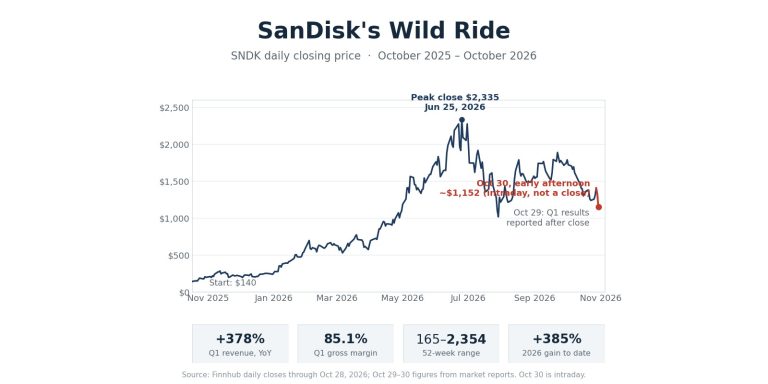
The selling spread to chipmakers and other technology stocks. CNN reported that a closely watched index of chipmakers sank about 9 percent. Advanced Micro Devices closed at $504.80, down 10.88 percent, and Nvidia closed at $204.64, down 4.22 percent. Reddit closed at $91.73, down 29.22 percent. Its earnings of $1.40 a share and revenue of $895 million beat expectations, but the company reported a decline in referrals from Google search and warned that daily active users could fall by a low double-digit percentage in the fourth quarter. SanDisk closed at $1,150.89, down 13.47 percent. Its quarterly results beat expectations, but the midpoint of its next-quarter outlook was only slightly above market expectations, and investors questioned how long the memory boom would last. Dell closed at $424.30, down 10.77 percent, and Barron’s reported that Intel’s weak outlook for personal computers dragged Dell and HP shares lower.
Investors moved money toward parts of the market less exposed to technology spending. CNN reported that money rotated into consumer staples and government bonds. Energy stocks held their gains. Exxon Mobil closed at $187.25, up 2.16 percent, and Chevron closed at $235.52, up 1.75 percent. Both reported quarterly profit above expectations. Reuters reported adjusted earnings of $4.23 a share at Exxon Mobil and $5.28 a share at Chevron. Profit from refining, the business of turning crude oil into gasoline and diesel, was strong as the war disrupted energy markets and pushed fuel prices higher.
Oil was a second pressure on the market. West Texas Intermediate crude futures closed at $104.12 a barrel, up about 2.1 percent, according to Longbridge. Reuters reported that the United Kingdom Maritime Trade Operations said a tanker crossing the Strait of Hormuz was hit by explosive devices attached by a small boat, causing a fire in the engine room and temporarily disabling the vessel. It was not immediately clear who was behind the attack. Reuters reported that the attack was the first successful strike using limpet mines, explosives attached to a ship’s hull by a small boat, in the waterway since the war between the United States and Iran began in February. The Strait of Hormuz is a narrow waterway through which a large share of the world’s traded oil passes, so threats to shipping there tend to push oil prices higher on fears of supply disruption.
There was no new shock from economic data. The Chicago Business Barometer fell to 55.3 in October from 58.8 in September, still in expansion, Dow Jones Newswires reported, although its prices paid measure rose 8.9 points to its highest level since December 2021. The yield on the 10-year Treasury note eased to about 4.95 percent in early-afternoon trading, according to Investor’s Business Daily. Market pricing for a December interest rate increase was little changed from morning readings.
CNN reported that the Nasdaq ended almost 9 percent below its record high from earlier in the month, and the S&P 500 ended 3.5 percent below its record high. Paul Stanley, a managing director at Arca, said in a note reported by CNN that the AI trade was down but not out, and that pullbacks had happened before. He wrote that the midterm elections on Tuesday were the next big test for markets.