
Polls Show Democrats Surging 29 Days Before Midterms, With Red States in Play

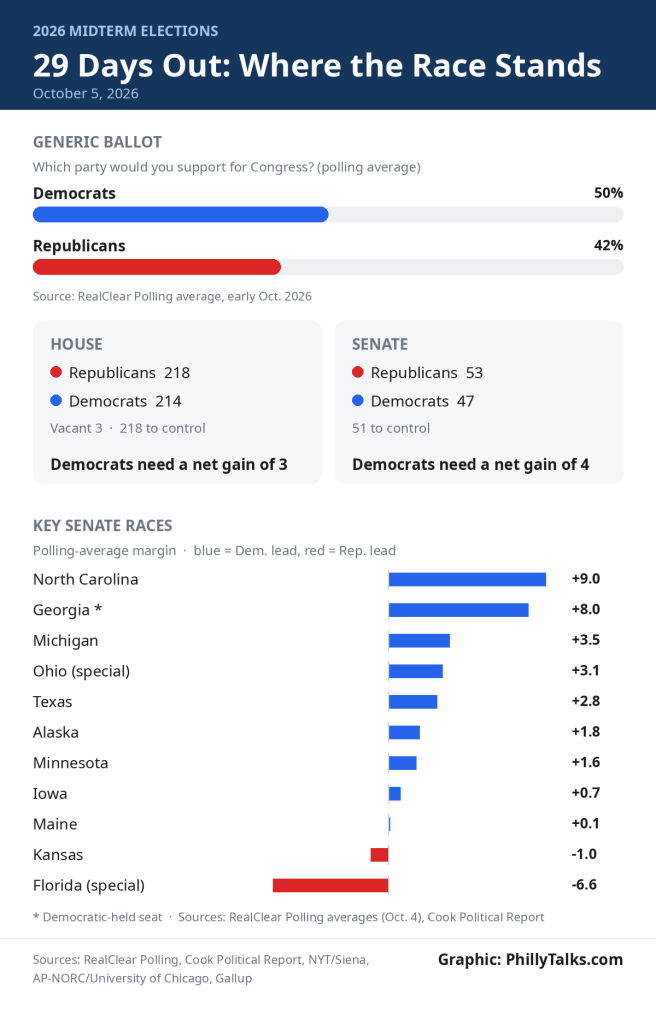
WASHINGTON — With 29 days until Americans vote in the midterm elections on Nov. 3, polling averages show Democrats holding a national lead of about eight to nine points, putting control of Congress in play.
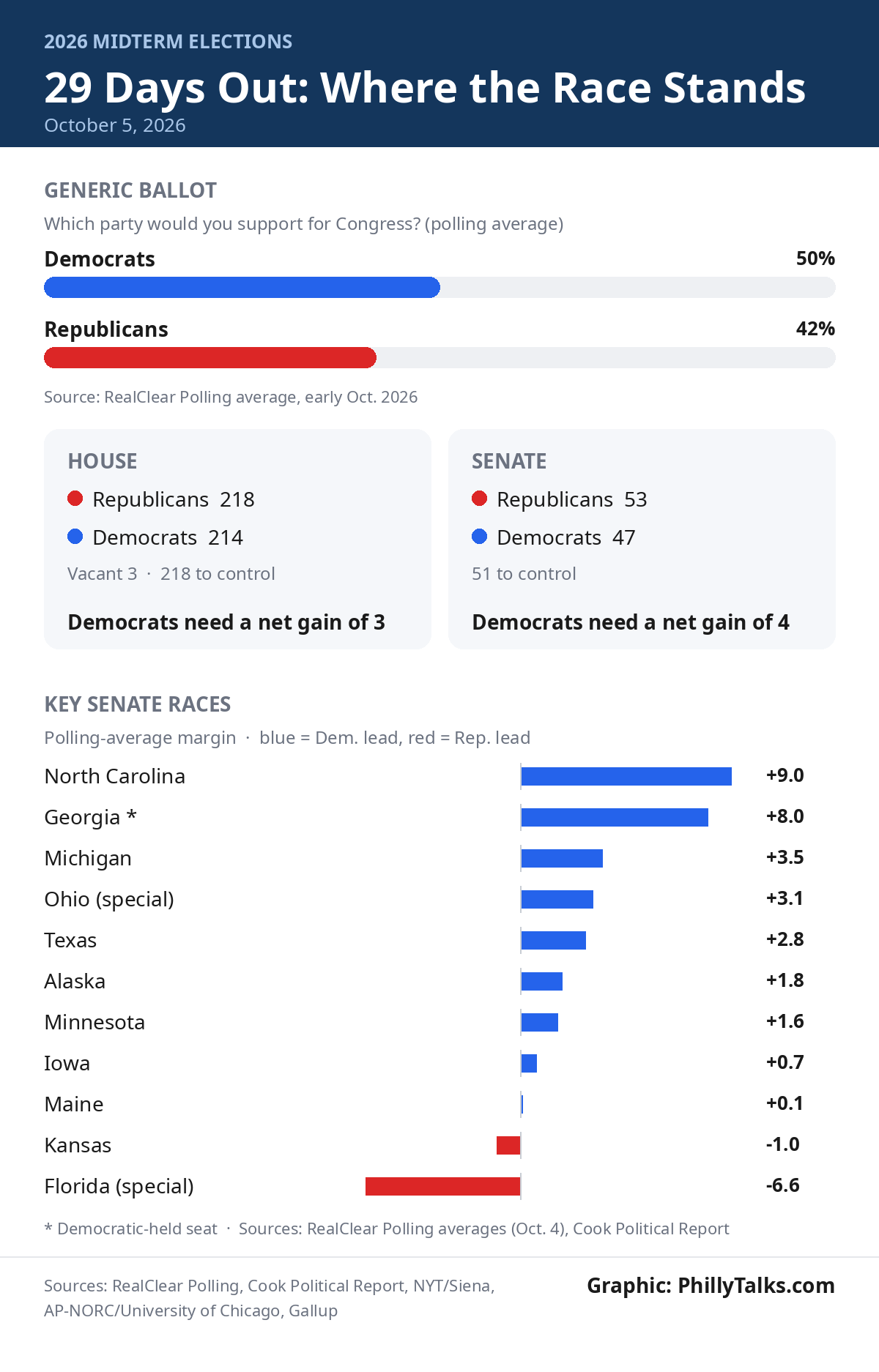
Midterm elections are held halfway through a president’s four-year term. All 435 seats in the House of Representatives, whose members serve two-year terms, are on the ballot. In the 100-member Senate, where members serve six-year terms, about a third of the seats are contested. It takes 218 seats to control the House and 51 to control the Senate.
In the House, Democrats need a net gain of just three seats. Republicans now hold 218 seats to the Democrats’ 214, with three vacant. The nonpartisan Cook Political Report projects Democrats will pick up between five and 15 seats. Polling averages compiled by RealClear Polling put Democrats ahead 50 percent to 42 percent on the generic congressional ballot, which asks voters which party they would support for Congress without naming candidates.
The House battleground is tilted in Democrats’ favor: 15 of the 19 races the Cook Political Report rates as toss-ups are held by Republicans. The most competitive districts include Arizona’s 6th, Colorado’s 8th and Michigan’s 7th. Pennsylvania has three of its own in play: the 7th, 8th and 10th districts, all held by Republicans. Most of these districts voted for Trump, but with his approval now underwater, they have shifted toward Democrats.
The Senate is a steeper climb. Republicans hold 53 seats to the Democrats’ 47, so Democrats need four more for a majority. Democrats are on offense in states Trump carried. Their targets include Texas, where the open seat pits Democrat James Talarico against scandal-embattled Attorney General Ken Paxton; North Carolina, where popular former Gov. Roy Cooper leads; Maine and Alaska, where Republican incumbents Susan Collins and Dan Sullivan face tight races; and Ohio, where former Sen. Sherrod Brown is attempting a comeback. Republicans’ best pickup chances are in Georgia against Democratic Sen. Jon Ossoff and in the open seats of Michigan and Minnesota.
Driving the numbers is the economy. Voters name the cost of living as their top concern, and recent surveys give Democrats an edge on handling prices. President Donald Trump’s approval rating sits below 40 percent, and 49 percent of voters in New York Times/Siena battleground polls said they want a candidate who would act as a check on the president, nearly double the 27 percent who prefer one who supports him.
Another pressure on household budgets comes from an unlikely source: the data centers that power artificial intelligence. The facilities consume enormous amounts of electricity, and in some states those costs have flowed into residents’ utility bills. About 84 percent of Americans are concerned about the effect on their electricity prices, according to a University of Chicago and AP-NORC survey, while Gallup found 70 percent oppose new data centers in their communities. A bill to make data centers help pay for grid upgrades passed the House but failed in the Senate on Sept. 30.
Republicans dispute the picture. Trump has called the polls “fake,” and his campaign is planning October stops in Texas, Alaska, Iowa and Florida, states the party once expected to hold easily. The party also holds a cash edge: its House campaign arm reported $89 million on hand compared with $76 million for Democrats, according to federal election filings.
Pollsters caution that surveys capture a moment, not an outcome. In Wisconsin’s Democratic gubernatorial primary, polls showed one candidate ahead by more than 20 points; she lost by less than one point, Reuters noted.
Whether the polling lead becomes seats will be decided over the next 29 days.