
Attacks on Ships and Soaring Insurance Costs Stopped Black Sea Grain Shipments

Ukrainian President Volodymyr Zelenskyy and Turkish President Recep Tayyip Erdogan agreed in Istanbul on Oct. 31 to work together on a Black Sea grain corridor. “Today, I reached an agreement with President Erdogan to work on the Black Sea grain corridor,” Zelenskyy said.
Erdogan said attacks on civilian vessels were unacceptable no matter who carried them out, and that talks to restore safe navigation would continue. No mechanism, timeline or guarantees for the corridor were announced. Russia did not take part in the meeting. Zelenskyy said he was preparing for trilateral talks with the United States and Russia in the first half of November. U.S. Secretary of State Marco Rubio said the same day that international interest was growing in a limited Black Sea ceasefire for grain and energy shipments and that the United States was reviewing proposals by Turkey and India.
Behind the meeting lie months of attacks on merchant shipping in the Black Sea and the resulting disruption to grain transport. No formal blockade was declared. Attacks on ships, soaring insurance costs, shipowners’ voluntary refusal to sail and the destruction of port facilities combined to produce the effect of a blockade through the private market.
Ships Under Attack
Until the summer, Russia chiefly attacked port facilities. From the summer, its tactics changed, and ships themselves came under attack regardless of flag. The shift followed Ukrainian strikes on Russia’s so-called shadow fleet of tankers in the summer, after which Russia intensified its attacks on ports, and Ukraine struck back at Russian grain and oil terminals at Novorossiysk.
The turning point was the July 19 attack on the Golden Leo. The Guinea-Bissau-flagged vessel, owned by Turkish interests, was carrying Ukrainian corn from Chornomorsk when it was hit by three cruise missiles. Ten people, including crew members and a harbor pilot, were killed, and the ship sank on July 26.
Shipowners then stopped calling at the ports of the Odesa region. On July 22, not a single commercial vessel entered the ports, the first such day since Ukraine opened its own maritime corridor.
In July alone, 57 merchant vessels were attacked, along with 67 port facilities, 35 vessels in port and 22 vessels at sea, according to Ukrainian authorities.
On Aug. 5, a Ukrainian seafarer was killed in an attack on the grain carrier Mera Queen.
In October, the attacks spread into the waters of NATO members. On Oct. 5, the Royad Mammadov, carrying corn from Izmail, was hit by drones in Romania’s exclusive economic zone, killing two crew members. Within 24 hours, the Able caught fire in Bulgarian waters and the Alfa Watan sank, leaving 10 crew members missing.
On Oct. 6, the Liberian-flagged tanker Rio was hit by uncrewed surface vessels off Sochi and caught fire. All 23 crew members were rescued. On Oct. 13, the Malta-flagged Chelsea 3 was hit by three drones 18 nautical miles east of Byala, Bulgaria, and the Azov Concorde sank off Krapets the same day. In late October, the Comoros-flagged Khoryv was hit by a drone 13 nautical miles off the Romanian port of Constanta.
Insurance Stopped the Sailings
On Sept. 16, the Joint War Committee in London expanded the war-risk listed area to almost the entire Black Sea, excluding only the 12-nautical-mile territorial waters of Turkey, Romania, Bulgaria and Georgia.
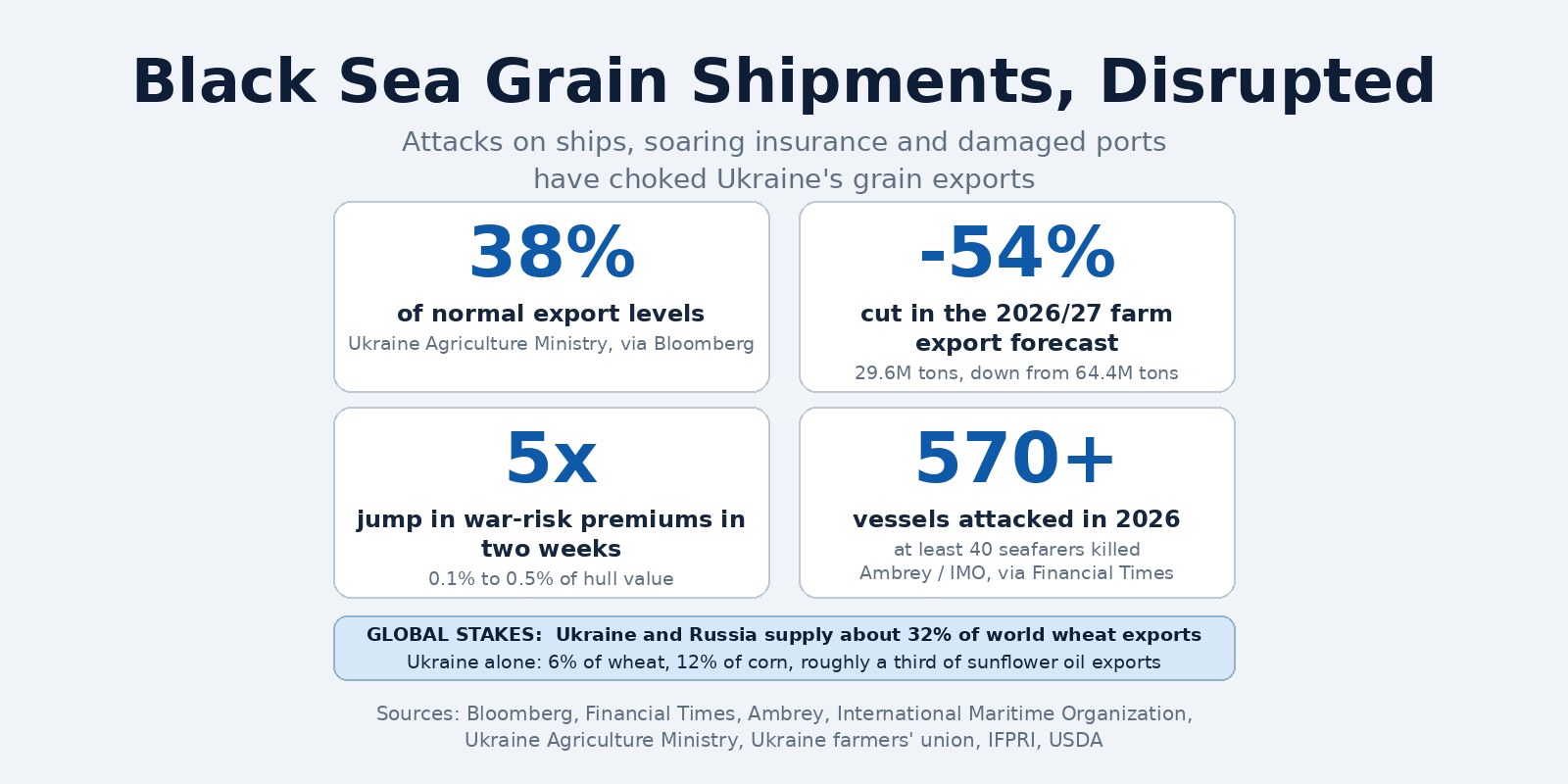
War-risk insurance premiums rose fivefold in two weeks, from 0.1 percent to 0.5 percent of a vessel’s hull value, according to Ukrainian shipowner Konstantin Sobol. Other firms saw rates of 0.6 to 1 percent, and the Financial Times reported rates as high as 15 percent for the riskiest voyages. The cost of insuring an oil tanker rose from about $200,000 a few months earlier to $2.5 million, according to a commercial administrator for the Bulgarian operations of the Russian oil and gas group Lukoil. Freight rates on some routes rose from $30 to $100 a ton in three months, shipping industry sources said.
With cover cancellable at short notice, shipowners, charterers and insurers refused to sail on their own. Maersk, Hapag-Lloyd and CMA CGM suspended services or rerouted them to Constanta in Romania.
Ports Blocked and Alternatives Fell Short
The destruction of port facilities continued. A third of grain storage capacity was lost, according to an analysis by the consultancy Barva Invest. Four of the ports’ 13 large grain terminals suspended purchases, and Kernel, the largest exporter, halted operations at Chornomorsk.
Ukraine’s exports now stand at 38 percent of normal levels, according to figures from the Agriculture Ministry reported by Bloomberg. The farmers’ union said port grain throughput fell from 6 million metric tons a month to 4 million.
The Agriculture Ministry’s forecast for farm exports in the 2026/27 season fell 54 percent, from 64.4 million metric tons to 29.6 million. Wheat exports could fall to 8.3 million tons, and wheat shipped so far, at 3.13 million tons, is about half the 5.61 million tons shipped in the same period last year. September farm exports of 2.4 million tons were 46 percent of the seasonal volume due.
Agriculture Minister Taras Vysotskyi said about 30 million metric tons of farm exports, worth about $10 billion, were at risk. The National Bank of Ukraine put export revenue losses for the second half of the year at $2.5 billion, equal to 0.9 percentage points of gross domestic product. Storage capacity of about 59 million tons could fill up by early November, with a shortfall of about 11 million tons by the end of autumn.
Alternative routes cannot make up the difference. The Odesa region ports handle about 90 percent of Ukraine’s farm exports and can process up to 40 million tons in a season. The Danube and rail routes carry only about 45 percent of the volume needed, with a maximum of 2.5 million tons a month against a requirement of 5 million. The Danube is also running at record-low water levels after a drought. “We cannot manage this volume of shipments by rail,” Zelenskyy told Bloomberg.
The impact extends beyond Ukraine. Ukraine and Russia together accounted for about 32 percent of global wheat exports in the 2025/26 season, according to the International Food Policy Research Institute. Ukraine alone accounted for about 6 percent of global wheat exports and about 12 percent of corn exports.
Ukraine’s main grain exports are wheat, at about 14 million metric tons, corn, at about 25 million, and barley, at about 1.52 million, in the forecast for the 2025/26 season. Those volumes represent about 6 percent, 12 percent and 4 percent of world exports, respectively, Deputy Minister of Economy, Environment and Agriculture Taras Vysotskyi said at an International Grains Council conference. The largest non-grain export is sunflower oil, worth $5.1 billion in 2025. The U.S. Department of Agriculture projects Ukraine will account for 31.3 percent of world sunflower oil exports in the 2026/27 season, second to Russia.
More than 570 vessels have been attacked in the Black Sea this year and at least 40 seafarers killed, according to figures compiled by the maritime security firm Ambrey and the International Maritime Organization and reported by the Financial Times. In the same period, there were 120 attacks and 24 deaths in and around the Strait of Hormuz.
Turkey brokered a Black Sea grain shipment deal with the United Nations in 2022. Russia withdrew from the agreement in 2023. Ukraine then opened its own maritime corridor, but the intensified attacks this summer have effectively stopped that corridor as well.