
France Burns as Its Politics Fails


A Saturday of Fire
On Saturday, Oct. 17, France burned. Some 550,000 people took to the streets nationwide — organizers put the figure at 800,000. In Paris alone, 110,000 marched. What began as peaceful demonstrations turned violent in the afternoon. Masked youths looted Celine and Dior boutiques in Paris; in Bordeaux, the windows of Apple, Louis Vuitton and Hermes stores were smashed. In Limoges, the 143-year-old city hall caught fire and its roof collapsed. Nationwide, 1,800 people were arrested and more than 500 police officers were injured. In Saint-Etienne, a 17-year-old boy picked up a police crowd-control grenade and lost his right hand. In Paris, one demonstrator died of a heart attack.
Why They Marched
What drove people into the streets is simple: life has become too expensive. According to INSEE, France’s statistics office, inflation hit 3.1% in September, the highest since January 2024. Energy prices rose 21.3% in a year — diesel up 44.1%, gasoline up 25.7%. Fresh food cost nearly 10% more. Wages stood still while bills soared, eroding purchasing power, the central issue of French politics. Youth unemployment reached 21.6%, up 2.5 points in a year. A student movement that began in September over crumbling schools was joined by unions and veterans of the 2018 yellow-vest protests, swelling into a national movement.
Three Crowds
One distinction matters. Most of the 110,000 who marched in Paris did so peacefully. The looters were a fraction. Police said “a new phase began” late in the afternoon “with the arrival of large numbers of people whose sole aim was to steal and loot.” Peaceful demonstrators, “black bloc” militants who deliberately operate without leaders, and opportunistic looters exploiting the chaos are three different groups. The problem is not that French youth are violent — it is that the three crowds blur together with no mediator to separate them.
A Lame-Duck President’s Statements
President Emmanuel Macron posted on X late Saturday: “No room for violence in our Republic. Those who have broken, attacked and looted will be prosecuted and punished.” He ruled out resigning. Beyond that, there is little he can do. With six months left in his term and no parliamentary majority, he has no votes to act on. One protester’s sign read: “Manu, can you feel it?” The street sees the president as the cause; the president has nothing to offer but condemnation.
A Paralyzed Parliament, a Zombie Government
The paralysis is structural. Macron’s 2024 snap election produced a hung parliament split among the hard left, the center and the far right, each refusing the others. Prime ministers have fallen in succession. Sebastien Lecornu survived two no-confidence votes Thursday only by buying Socialist votes — at the price of freezing Macron’s pension reform until after the 2027 presidential election. The government survives but can do nothing. The next tests: an Oct. 20 revenue vote and a Nov. 17 vote on the full budget.
The Math of the Pension Pot
The pension fight needs explaining first. France’s pensions run on a simple flow: today’s workers pay for today’s retirees. But retirees grow in number while workers shrink and lives lengthen. When outflows exceed inflows, the pot runs dry — and then nobody gets a pension. Macron’s plan to raise the retirement age from 62 to 64 meant two more years of contributions and two fewer years of payouts: an attempt to save the welfare state, not destroy it.
Article 49.3, the Double-Edged Sword
The method was the problem. The government rammed the reform through with Article 49.3, a constitutional device letting it pass a bill without a parliamentary vote. The only recourse is a no-confidence motion within 24 hours passed by absolute majority. Charles de Gaulle created it in 1958 to prevent parliamentary paralysis; Macron’s governments used it 23 times. Even if the math was right, the strong-arm method read as undemocratic — and trust collapsed.
The Welfare Paradox
Here lies France’s paradox. According to Eurostat, France collects 44.3% of GDP in taxes — the highest in the eurozone. INSEE puts government spending at 57.2% of GDP, the EU’s highest. It was the world’s model welfare state. But the model assumed growth would pay for it. Growth stalled; crises piled up. Public debt stands at 119% of GDP (INSEE, second quarter 2026), a postwar record; the Finance Ministry forecasts 119.3% this year and 121.7% next. The deficit runs at 5.4% of GDP — nearly double the EU’s 3% ceiling. The IMF’s June review saw 5.2%; the European Commission warns of 5.7% in 2027 without policy change. Interest payments alone cost 62.6 billion euros this year, rising to 72.9 billion next year — more than defense. Taxes are the world’s highest, yet schools crumble and hospitals lack staff. The sense of betrayal — paying the most, getting less — is what exploded in the streets.
A Debt-Laden State, World-Class Companies
None of which means the French economy has collapsed. The state’s coffers are empty, but its companies are world-class. LVMH, Hermes and Chanel dominate global luxury; Airbus has overtaken Boeing as the world’s largest planemaker. France draws 70% of its electricity from nuclear power — the world’s highest share — giving it energy independence. It is the world’s most-visited country and home to L’Oreal, the top cosmetics firm. CAC 40 giants earn most revenue abroad. A debt-burdened state, world-beating firms: the gap is the essence of the crisis.
Why Growth Won’t Come
The reasons growth has stalled stack up. Heavy taxes deter investment; rigid hiring rules make firms afraid to recruit. Factories moved abroad; who builds a plant in a country where prime ministers change several times a year? INSEE recorded minus 0.2% growth in the first quarter and 0.0% in the second; the IMF’s October outlook sees 0.4% for the year. The population ages while the workforce shrinks. Heavy taxes, tight rules, unstable politics, an aging people — no single fix will do, which is what makes it hard.
The Soil of the Far Right
In this soil the far right grows. A decade of terror attacks and insecurity, a collapsed left and a failed center, the National Rally’s rebrand as the party of purchasing power, and the fury of provincial France ignored by Paris elites converged. Marine Le Pen spent a decade detoxifying the party — expelling her father, dropping euro-exit demands — while Jordan Bardella talks fuel prices to win workers’ votes.
Immigration at the Heart
Immigration sits at the heart of the crisis. INSEE reported in June that France has nearly 8 million immigrants — 11.6% of the population, the EU’s largest. Most come from former colonies such as Algeria, Morocco and Tunisia, and many are second- and third-generation French citizens concentrated in the banlieues, facing job discrimination. France’s creed was assimilation: whoever becomes French is equally French. Reality differed. The 2023 police killing of 17-year-old Nahel, of Algerian descent, set off nationwide riots; Macron’s 2024 immigration law, passed with far-right votes, split his own camp. The National Rally now pledges “national preference” — barring legal foreign residents from public housing, welfare and jobs, a move analysts call unconstitutional and a breach of EU law. Beneath the security debate lies the question of what it means to be French. The banlieues have exploded on the same pattern in 2005, 2023 and now.
Why the EU Can’t Help
The EU can do almost nothing. The excessive-deficit procedure allows fines, but there is no precedent for fining the EU’s second-largest economy. The European Central Bank’s bond-buying backstop applies to “unwarranted” market panic — but France’s rising yields are warranted by its 5.4% deficit, as the Bruegel think tank noted in October. A bailout would demand Greek-style austerity no French government could accept. Eurozone finance ministers said it plainly: sort out your own mess.
The Whole Eurozone Shakes
When France shakes, the eurozone shakes. France accounts for 18.8% of euro-area GDP (Eurostat). When French bonds sell off, investors ask who’s next, and Italian yields follow. In mid-October the French-German 10-year spread hit 130 to 140 basis points, overtaking Italy and Greece for the first time since the 2012 euro crisis (Reuters). Rating agencies moved: Fitch and S&P at A+, Moody’s Aa3 with negative outlook, Scope downgraded France in September. France is ten times Greece’s size — harder to extinguish. EU fiscal rules crumble when the second-largest economy ignores them; when the Franco-German axis stalls, the EU stalls.
The Election and Market Timetable
If the far right wins the April 2027 presidential election, expect hardline immigration policies — but the 5.4% deficit math defeats them too, and tax-cut pledges could widen it further. Markets fear this scenario most. The National Rally says it won’t leave the euro. As a permanent U.N. Security Council member and nuclear power, a far-right France could align with Italy’s Meloni and Hungary’s Orban, reshaping EU dynamics and shaking Ukraine aid.
Solutions Without Consensus
Solutions exist; consensus doesn’t. Austerity lacks votes and would inflame the streets — and cutting into zero growth shrinks the economy faster than the debt. Taxing the rich can’t fill the hole. A grand coalition is impossible among camps that call each other enemies of the republic. Snap elections would likely return another hung parliament — or a far-right win markets dread. The likeliest path: muddle through to April 2027, then wait for bond markets to force action. France and EU crises have always resolved that way — the most painful, most certain route.
The Numbers to Watch
The markers are set: the Oct. 20 revenue vote, the Nov. 17 full budget vote, the 122 National Rally deputies holding the no-confidence balance, the French-German spread, any use of Article 49.3, the rating agencies, and the April 2027 election.
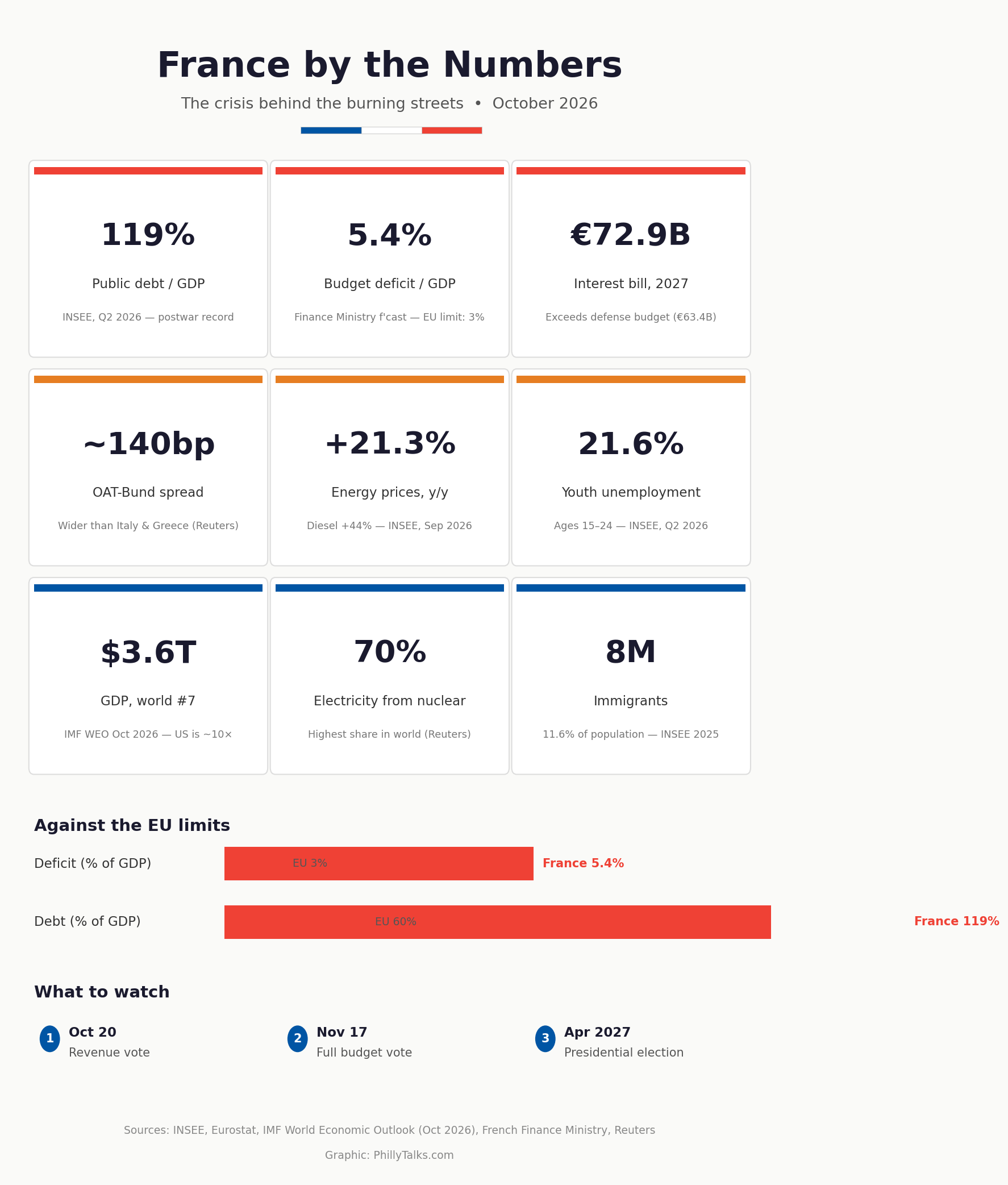
The IMF’s October outlook ranks France the world’s seventh-largest economy at $3.6 trillion — less than a tenth of America’s $30 trillion. Big brother of Europe, not master of the world. Yet France remains the country the eurozone can neither let fail nor rescue. The flames over Paris showed the world that paradox.